Weight Training
Builds Senior Muscle
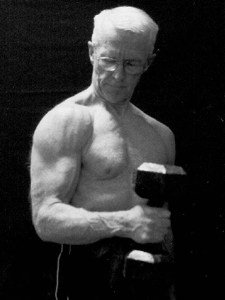
The miracle of weight training is that it slows muscle tissue loss associated with aging. In fact, it is even possible to regain muscle that has been lost. Cardiovascular training and stretching have their place in a balanced fitness plan. But it is progressive resistance exercise that builds muscle, allowing us to stay young, active, and independent for as long as possible. Nothing else comes close to being as effective.
Inactive men and women over age 30 slowly lose muscle tissue every year. At about age 50 this loss of muscle (and strength and endurance) starts happening faster. And after age 65, it accelerates even more. Scientists have a name for it. They call it "sarcopenia.” It is from the Greek, meaning “poverty of flesh.” It is what we see in frail, elderly people who are bent over from a combination of osteoporosis and sarcopenia, the wasting away of muscle tissue.
Age will take its toll, of course. But a poor diet and sedentary
lifestyle will greatly accelerate the decline. While exercising with
weights applies the brakes. In fact, with proper nutrition and this kind
of training, muscle can not only be retained, some that has been lost
can be rebuilt. It is the safest natural prescription there is for
anti-aging. Put another way, barbells and dumbbells are the antidote to sarcopenia.
|
|
Weight training is popular today with people of all ages, but it is not new. Progressive resistance exercise began in southern Italy in about 500 B.C. A man named Milo decided to shoulder a small calf and carry it the length of the stadium at Olympia. The story goes that he continued carrying it regularly until it was full grown. As the animal got heavier, Milo got progressively stronger.
Understanding the story of Milo is to understand the foundation of all progressive resistance training programs. You begin by lifting something that is very manageable and gradually add to it over time.
While lifting barbells and dumbbells is the most common form of this kind of weight training, bodyweight exercises, Pilates, resistance bands, kettlebells, sandbags, and various fitness machines and devices can also be used to provide progressive resistance. Even water aerobics, though classified as cardiovascular, is really a form of resistance training.
Starting out right
Senior
beginners should first have a physical examination and discuss with
their doctor their plan for a fitness weight training program. If some
activities or exercises should for any reason be restricted, you want to
know about it before beginning a program. Next, you should arrange to
get proper instruction. Follow a beginner's program or schedule a few sessions with a personal trainer
to get off to a good, safe start. Doing too much too soon or using
improper lifting techniques can lead to setbacks, or something more
serious. Resistance exercise is great! But be smart and do age
appropriate training.
-Logan Franklin
Other resources . . .
Master Trainer
Richard Winett, Ph.D., offers training advice for senior athletes.
Return from Weight training Builds Senior Muscle to Senior-Exercise-Central.com
 Subscribe To My Blog


Subscribe to my Free
Gray Iron Fitness
(twice monthly)
Newsletter
Here is what our subscribers are saying . . .
"Thank you for your newsletter. I loved it, and please keep them coming. I found the last one very inspiring. I like the food control portion a lot." -Amy Harwood
"My wife and I are just now starting to get off the couch and back in shape . . . we have a ways to go but you two are an inspiration." -Joey & Lynn Everhart
"Thanks Logan for your inspiring newsletter each month. I have taken your advice and am riding my stationary bike 20 minutes each morning and just started using my Weider Crossbow. I am feeling better each day." -Dennis C. Ewert (64 years old)
"As an almost-52 year old woman who's just gotten 'turned on' to weightlifting, I really appreciate your newsletter and look forward to getting it." -Wanda Araujo
"Really enjoyed your thoughts on retirement in the latest newsletter." -Larry, 56
"Great articles. I look forward to your newsletter and the interesting and informative articles you share." --Pete
"I love your newsletter. May it go on forever."- TJ Granack